Raksha
The Jungle BookRaksha, known as Mother Wolf and, because of her ferocity, The Demon, is the wolf who transforms Mowgli’s arrival into an act of adoption and defiance. She recognizes the naked, fearless child as more than prey or intruder: she makes him her son, protects him from Shere Khan, and later receives him again when he returns carrying the tiger’s hide. Her role is concentrated in decisive moments, but those moments define Mowgli’s earliest belonging and give emotional force to his later promise and revenge.
Identity and First Recognition
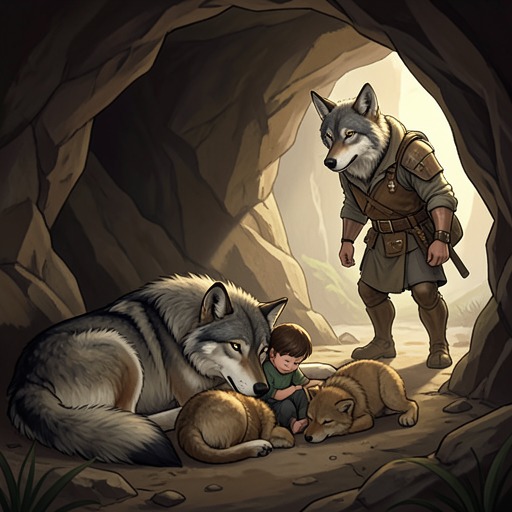
Raksha first encounters Mowgli when Father Wolf brings the child into the cave and lays him among the wolf cubs without injuring him. She sees that he is tiny, naked, and bold, yet already pushing between the cubs toward the warmth of the family and taking his meal with them. Her response is not fear but astonished recognition: the man-cub has entered the den as though he belongs there.
The name Raksha carries an explicit association with danger. Father Wolf remembers that she had once fought five other wolves to win her place, and that The Demon was no mere compliment. Her identity therefore joins maternal tenderness to physical courage. The same wolf who can cradle the helpless child among her cubs can also confront the most threatening predator in the jungle without surrendering ground.
Defiance of Shere Khan
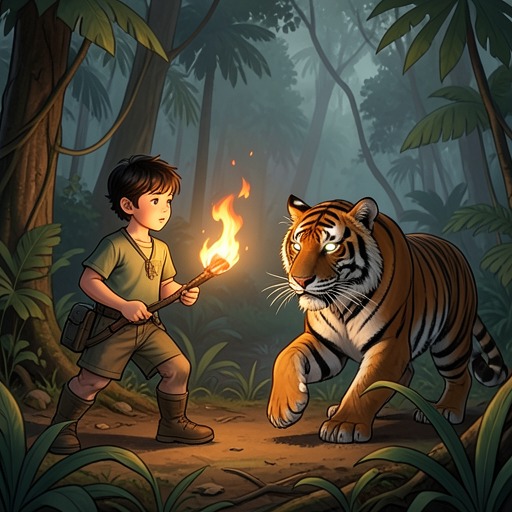
Shere Khan comes to the cave claiming the man-cub as his prey, with Tabaqui helping him track the child. His roar fills the den, but Raksha moves out from among the cubs and faces him. She answers his authority with her own, declaring that the man-cub is hers and that he will live to run and hunt with the Pack rather than be killed.
Her defense is also a prophecy. Raksha tells Shere Khan that the child will one day hunt the tiger who has hunted him. The threat reverses the expected relation between predator and prey: the apparently helpless human infant becomes the future danger, while the powerful tiger is marked as the hunted. Shere Khan knows that Raksha has the advantage of the cave and that she will fight to the death, so he retreats while insisting that the Pack will decide the child’s fate.
Raksha’s judgment is practical as well as emotional. She argues that Shere Khan would have killed Mowgli and then fled toward the Waingunga, leaving the villagers to search the wolf lairs in revenge. Keeping the child protects not only Mowgli but the den and its cubs from the consequences of the tiger’s violence. Her motherhood is thus an active political choice within the jungle’s dangerous network of claims, reprisals, and communal rules.
Motherhood and Belonging
When Father Wolf asks whether she will still keep the child despite the Pack’s authority, Raksha answers with certainty. Mowgli arrived alone, hungry, and unafraid; he had already pushed one of her own cubs aside, a small gesture that shows both his boldness and his immediate participation in the family’s physical life. Raksha calls him Mowgli, meaning Mowgli the Frog, preserving the image of a small, naked creature while giving him a name within wolf society.
Her attachment deepens beyond formal fosterage. At their later parting, Raksha tells Mowgli that she loved him more than she had ever loved her own cubs. The statement does not erase his wolf siblings; it emphasizes the extraordinary force of the bond created across species. Mowgli is not merely tolerated under the Law of the Jungle. He is claimed, named, remembered, and loved as a son.
That belonging is tested by the Pack’s established procedure. Once cubs are old enough to stand, they must be brought before the Pack Council at the full moon so that the wolves can identify them. Raksha’s private decision therefore has to enter a public system of recognition. Her adoption begins in the intimate darkness of the cave, but its survival depends on whether the wider wolf community will accept what she has chosen.
Promise, Separation, and Return
Raksha’s relationship with Mowgli remains present even after he leaves the hillside to encounter human society. At the moment of separation, she and Father Wolf ask him to return, and Raksha calls him her little naked son. Mowgli promises that he will come back, carrying the hide of Shere Khan to the Council Rock. His vow gives narrative form to the prophecy Raksha made when he was an infant: the child she saved will become the hunter of his enemy.
Years later, Mowgli returns after being cast out from the Man-Pack. He brings Shere Khan’s skin, fulfilling the promise he made to Raksha. She walks stiffly from the cave with the cubs behind her, and her eyes glow when she sees the hide. Her response confirms that she has preserved the memory of the first encounter and has understood Mowgli’s return not as a stranger’s visit but as the completion of an old obligation between mother and son.
At the Council Rock, Mowgli spreads the skin on the flat stone where Akela used to sit and fastens it with four bamboo slivers. Akela lies upon it and calls the old council summons, echoing the ceremony through which Mowgli was first presented to the wolves. Raksha’s original act of protection thus reaches its symbolic conclusion: the child once threatened at the cave mouth returns bearing proof that the future she imagined has been realized.
Narrative Significance
Raksha represents a form of kinship founded on care, courage, and chosen allegiance rather than species or birth alone. The child’s human origin does not prevent her from recognizing him as a member of her household, while the jungle’s rules provide a framework through which that exceptional adoption can become socially legible. Her motherhood is neither passive nor sentimental; it confronts violence, calculates danger, and speaks in the language of future consequences.
Her first defense of Mowgli also establishes one of the book’s recurring reversals: apparent weakness can contain an unforeseen power, and a creature’s assigned category need not determine its fate. Mowgli is a man-cub, but Raksha gives him a wolf family, a name, a law, and a promised future. When he finally returns with Shere Khan’s hide, the narrative confirms that her fierce claim was both an act of love and the first declaration of the conflict that will shape his life.